Section A: Understanding the study
Who took part and what happened in the three rooms
The participants
The children were 36 boys and 36 girls from the Stanford University Nursery School in California. They were aged between 37 and 69 months, roughly three to almost six years old, and their average age was 52 months, about four and a third years.
Three adults took part as well: one man and one woman who acted as the models, and one woman, the experimenter, who ran the sessions for all 72 children.
The paper gives no information about the children's families, social class or ethnicity. They were children at a university nursery school, and you should not assume more than that.
Making the groups fair
Some children are more aggressive than others before any experiment begins. If, by chance, the most aggressive children all ended up in one group, that group would look more aggressive whatever the model did. To prevent this, the researchers matched the children before dividing them.
- The experimenter and a nursery teacher, who both knew the children well, rated each child on four five-point scales: physical aggression, verbal aggression, aggression towards objects, and aggressive inhibition, meaning how much a child held back when provoked.
- The four ratings were added together to give each child an aggression score.
- Children with similar scores were put into sets of three, called triplets.
- Within each triplet, chance decided which child went to watch the aggressive model, which went to watch the non-aggressive model, and which saw no model.
So each condition received one child from every triplet, and the three conditions started with almost the same level of aggression.
In an experiment, each of the groups being compared is called a condition. The group that sees no model is the control group. Nothing is changed for it, so it shows how children behave anyway, and the other conditions can be compared with it.
How reliable were the ratings?
For 51 children, the experimenter and the teacher rated independently. Their combined scores agreed closely: the correlation was .89 (Pearson's r), where 1.0 would be perfect agreement. This is called inter-rater reliability.
How the 72 children were divided
Each dot is one child. Each small cluster is one of the nine groups.
- Girl (36 in total)
- Boy (36 in total)
Aggressive model 24 children
6 girls
female model
6 girls
male model
6 boys
female model
6 boys
male model
Calm (non-aggressive) model 24 children
6 girls
female model
6 girls
male model
6 boys
female model
6 boys
male model
No model (control) 24 children
12 girls
saw no model
12 boys
saw no model
Source: Bandura, Ross and Ross (1961), p. 576. Eight experimental groups of six children, plus a control group of 24.
The aggressive and non-aggressive conditions were each split four ways: girls with a female model, girls with a male model, boys with a female model and boys with a male model. That makes eight groups of six children. The 24 control children saw no model at all.
The three rooms
Each child went through the procedure one at a time, in three stages.
-
Room 1: watching
About 10 minutes
The child does potato prints and stickers in one corner. An adult model plays in the other corner, either attacking a 5-foot Bobo doll or quietly building with Tinkertoys. Control children skip this stage.
-
Room 2: mild frustration
About 2 minutes
The child starts playing with very attractive toys. Then the experimenter says these are her best toys and she is keeping them for other children.
-
Room 3: the test
20 minutes
The child plays freely in a room with a 3-foot Bobo doll and other toys. Observers behind a one-way mirror record what the child does every five seconds.
Room 1: watching the model
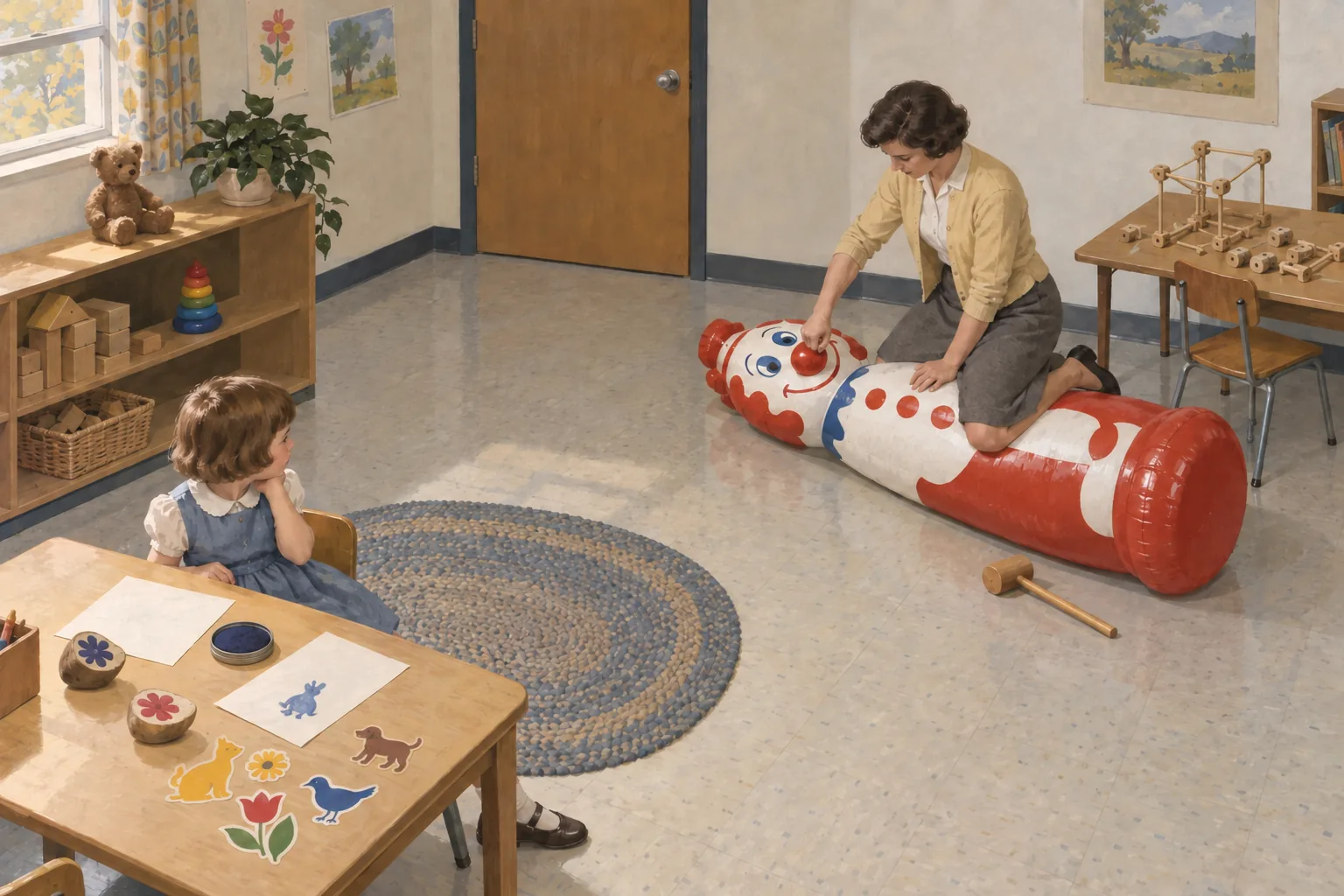 Illustrated reconstruction
Room 1, aggressive condition. The child has an interesting task of her own, but she can see everything the model does. Notice the mallet and the Tinkertoys: the aggressive and non-aggressive models had exactly the same materials. This is an illustration based on the paper's description, not a photograph of the study.
The experimenter brought each child to the room. On the way, the model was waiting in the hallway and was "invited to come and join in the game". The child was seated at a small table in one corner with potato prints (half potatoes carved into shapes and used as stamps) and colourful stickers, activities that earlier observation had shown these children enjoyed. The model was taken to the opposite corner, which had a small table and chair, a set of Tinkertoys (wooden building pieces), a mallet and a 5-foot inflatable Bobo doll. Then the experimenter left the room.
The child was never told to watch the model or to learn anything. The stickers kept the child busy, but the model was in plain view.
In the non-aggressive condition, which later pages also call the calm condition, the model built with the Tinkertoys "in a quiet subdued manner totally ignoring the Bobo doll" for the whole time.
In the aggressive condition, the model built with the Tinkertoys for about a minute and then attacked the Bobo doll for the rest of the session. The researchers chose unusual acts on purpose. Children punch dolls without being shown, so an ordinary punch would prove nothing. Unusual acts, copied exactly, would show learning. The paper describes the sequence like this:
The model laid the Bobo doll on its side, sat on it and punched it repeatedly in the nose. The model then raised the Bobo doll, picked up the mallet and struck the doll on the head. Following the mallet aggression, the model tossed the doll up in the air aggressively and kicked it about the room.
Bandura, Ross and Ross (1961), p. 576
The model repeated this sequence about three times, saying things such as "Sock him in the nose", "Hit him down", "Throw him in the air", "Kick him" and "Pow". The model also made two non-aggressive comments: "He keeps coming back for more" and "He sure is a tough fella".
After 10 minutes the experimenter came back, told the child it was time to go to another game room, and said goodbye to the model.
Room 2: mild frustration
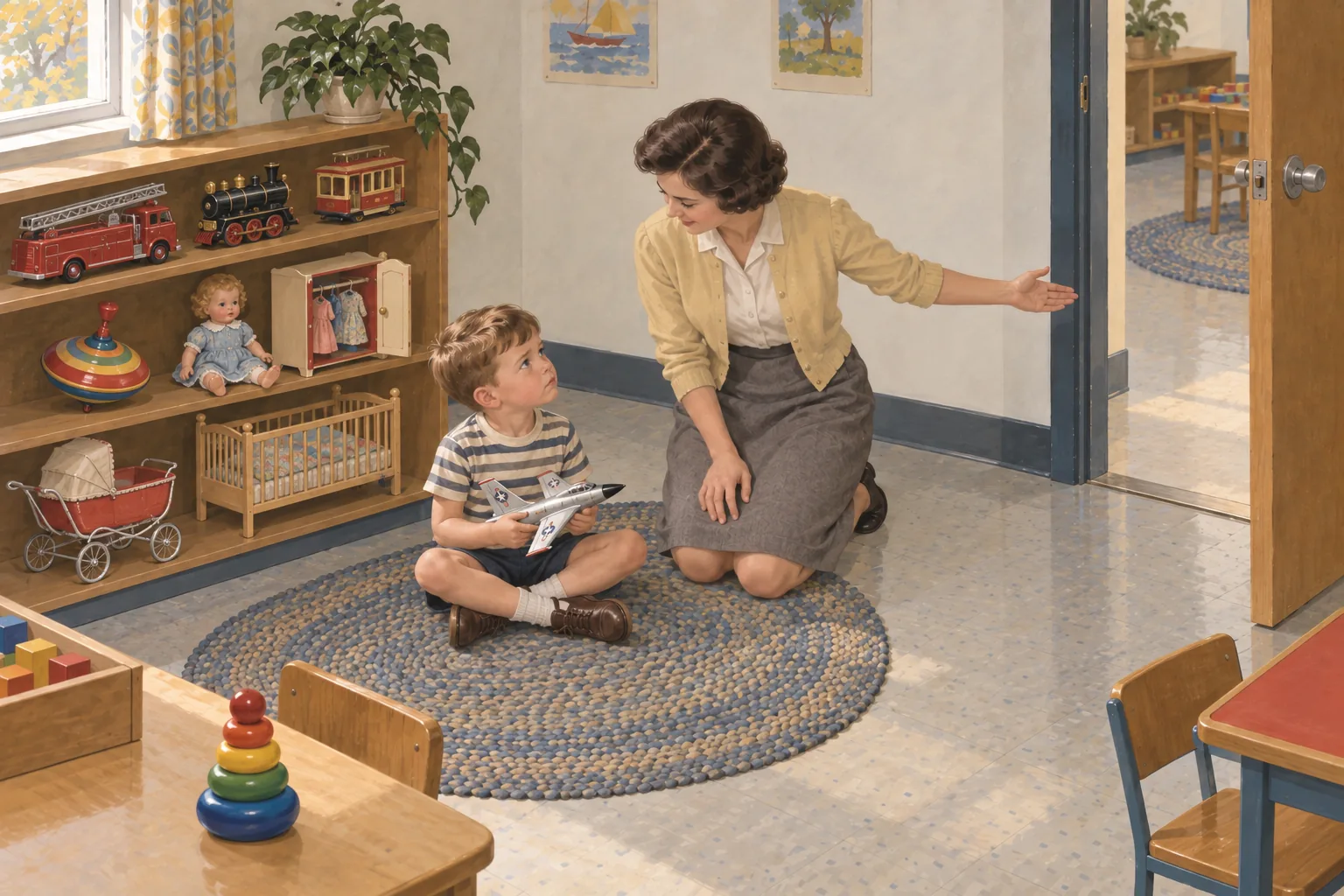 Illustrated reconstruction
Room 2. Every child, including the control children, went through this step. The toys listed in the paper are all here: a fire engine, a locomotive, a jet fighter plane, a cable car, a spinning top, and a doll set with wardrobe, doll carriage and crib.
The test took place in a room "set off from the main nursery school building". Many children thought they had left the nursery grounds altogether.
First, in a small anteroom, the experimenter let each child play with very attractive toys. As soon as the child was involved, usually after about two minutes, she said that these were her very best toys, that she did not let just anyone play with them, and that she had decided to keep them for the other children. The child could, however, play with any of the toys in the next room.
Why do this? The paper gives two reasons. First, the researchers expected, from an earlier study, that watching aggression might reduce a child's own urge to be aggressive, so all children needed some push towards aggression before the test. Second, if children who had watched the calm model stayed calm even after being frustrated, that would show that the calm model had restrained them.
Room 3: the test
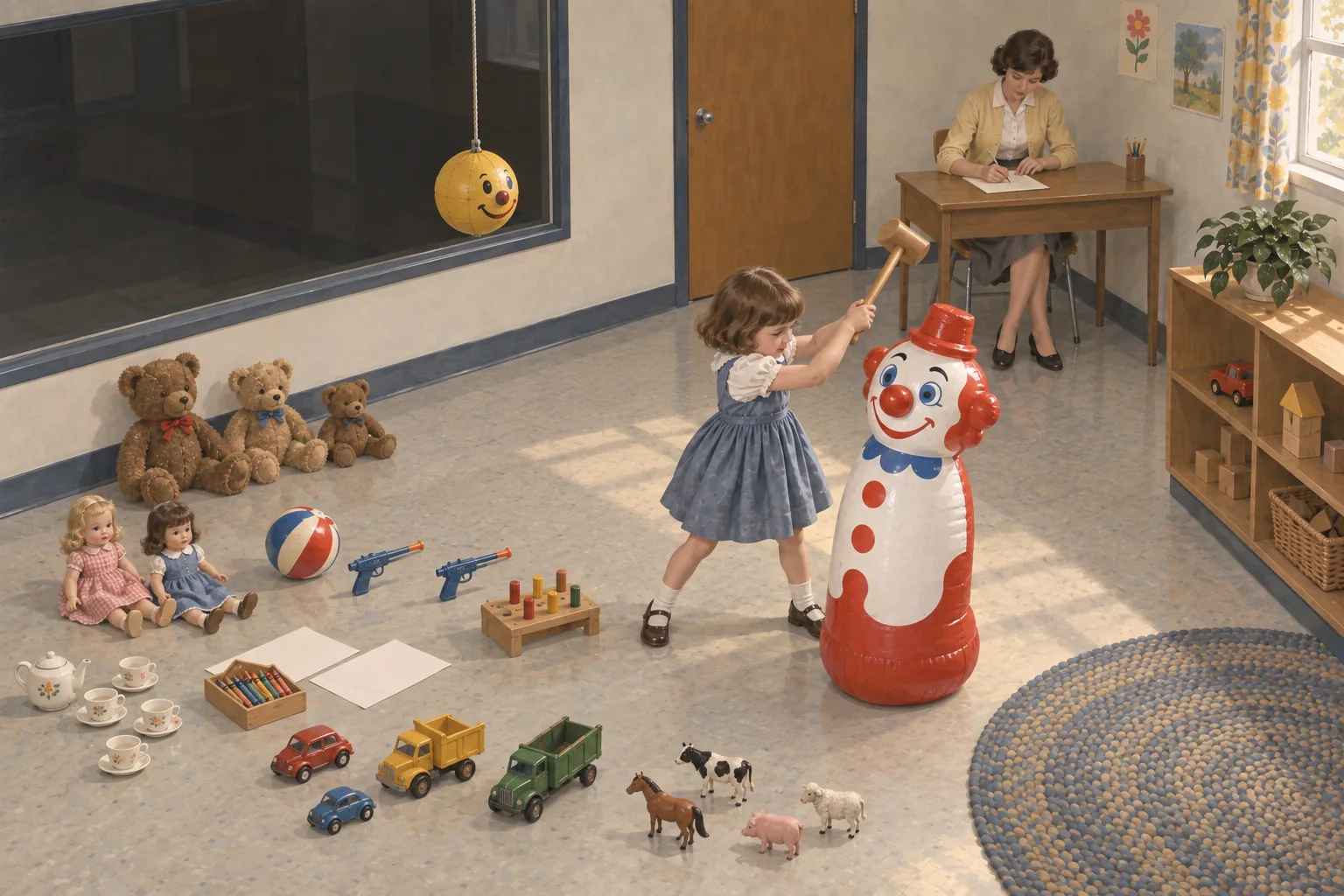 Illustrated reconstruction
Room 3, the test room. Notice that the experimenter is in the room, doing paperwork at a desk. Notice also that this Bobo doll is smaller than the one in Room 1: 3 feet instead of 5. The dark panel on the wall is the one-way mirror the observers watched through.
The test room contained two kinds of toys, always arranged in the same places:
- Toys that could be used aggressively: a 3-foot Bobo doll, a mallet and peg board, two dart guns, and a tetherball with a face painted on it hanging from the ceiling.
- Toys that usually lead to non-aggressive play: a tea set, crayons and colouring paper, a ball, two dolls, three bears, cars and trucks, and plastic farm animals.
The child played here for 20 minutes. The experimenter stayed in the room, because a number of the children would otherwise refuse to stay alone or would leave early. She sat at a desk in the far corner doing paperwork and avoided talking to the child.
Observers watched through a one-way mirror, a window that looks like a mirror from the child's side. An electric timer divided the 20 minutes into five-second intervals, 240 in total, and the observers recorded which kinds of behaviour happened in each interval. Recording behaviour at fixed time intervals like this is called time sampling.
What the observers counted
The researchers defined each category of behaviour in advance, so that observers would be counting the same things.
| Category | What counted | Type |
|---|---|---|
| Imitative physical aggression | Sitting on the doll and punching its nose, hitting it with the mallet, kicking it, tossing it in the air | Exact copy of the model |
| Imitative verbal aggression | Repeating "Sock him", "Hit him down", "Kick him", "Throw him in the air" or "Pow" | Exact copy of the model |
| Imitative non-aggressive speech | Repeating "He keeps coming back for more" or "He sure is a tough fella" | Exact copy of the model |
| Mallet aggression | Hitting things other than the doll with the mallet | Partial copy |
| Sits on Bobo doll | Laying the doll down and sitting on it, without hitting it | Partial copy |
| Punches Bobo doll | Hitting, slapping or pushing the doll in ordinary ways that children do without being shown | Not counted as copying |
| Non-imitative aggression | Other physical aggression, and hostile remarks the model never said, such as "Shoot the Bobo" or "Cut him" | Not counted as copying |
| Aggressive gun play | Shooting darts, or aiming the guns and firing imaginary shots | Not counted as copying |
The observers also recorded calm play and sitting quietly without playing.
Who scored the sessions?
The male model scored all 72 sessions. He knew which condition a child was in only for the children he had modelled for. A second observer scored half the children independently, and their agreement was high, with correlations in the .90s. But the authors admit that children who had seen the aggressive model "could be readily identified through the distinctive behavior", since all but two of them copied the model's unusual acts. So the scoring was not fully blind, meaning the scorers could often guess the condition.
Try this
A student designing a replication says: 'Matching on aggression is unnecessary. With random assignment, the groups will be equal anyway.'
Why did Bandura, Ross and Ross match the children before randomly assigning them, given that each group had only six children?
Show the reasoning
Random assignment makes groups equal on average when groups are large. With only six children per group, chance can easily put two or three very aggressive children in the same group, and that alone could change the group's average a great deal.
Matching in triplets first, then assigning randomly within each triplet, guarantees that every condition gets one child from each level of aggression. It keeps the benefit of random assignment, since chance still decides which child goes where, while removing the risk of unlucky splits. This design is called a matched-groups design, and it is especially useful when samples are small.