The Bobo doll study
Will young children copy aggression that they have only watched?
Bandura, A., Ross, D., & Ross, S. A. (1961). Transmission of aggression through imitation of aggressive models. Journal of Abnormal and Social Psychology, 63(3), 575-582. doi:10.1037/h0045925
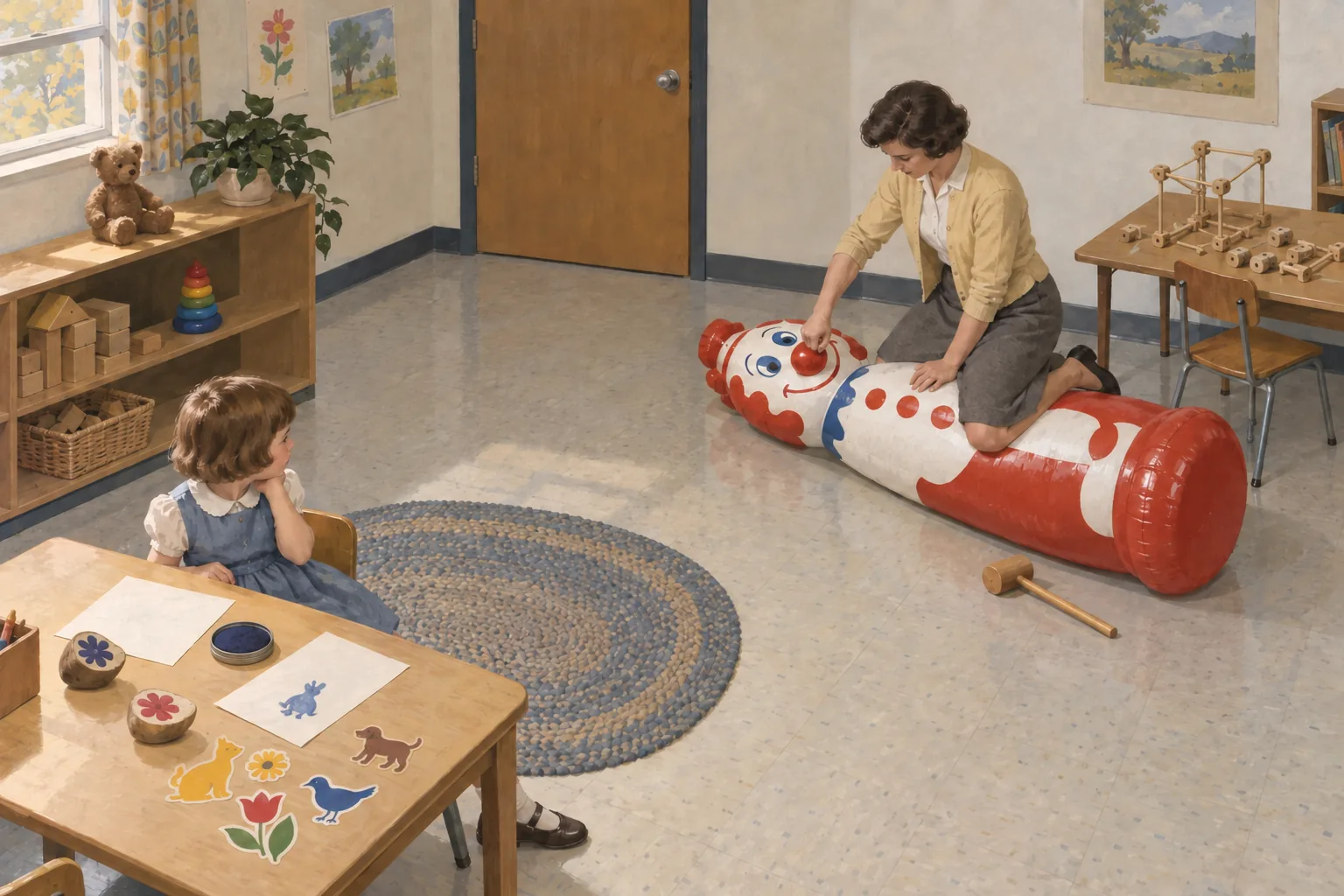 Illustrated reconstruction
In about 1960, at Stanford University in California, 72 children aged three to five took part in a simple experiment. Some watched an adult attack a large inflatable clown, a Bobo doll, with punches, kicks, a mallet and shouts of "Pow!". Some watched an adult play quietly. Some saw no adult at all.
A few minutes later, each child was taken to another room with a smaller Bobo doll and left to play while the experimenter did paperwork in a corner. Many of the children who had watched the aggressive adult copied the adult's exact acts and words. The other children almost never did.
The study showed that children can learn new behaviour just by watching, with no reward. It led to Bandura's social learning theory and to decades of argument about violence on screen. It is also a good case for practising critical analysis, because almost every perspective in your course reads it differently.
- Authors
- Albert Bandura, Dorothea Ross and Sheila A. Ross
- Published
- 1961, Journal of Abnormal and Social Psychology
- Where
- Stanford University Nursery School, California, USA
- Participants
- 72 children (36 boys, 36 girls), aged 37 to 69 months
- Design
- Laboratory experiment with matched groups: aggressive model, calm model or no model
- In Hock
- Reading 12, "See aggression... do aggression!"
Start reading: Before the study The whole guide takes about 170 minutes. Each page takes 5 to 15.
What is in this guide
Understanding the study
- Before the study What psychologists believed about learning and aggression in 1961, and the puzzle Bandura wanted to solve.
- Question and hypotheses What the researchers asked, the four things they predicted, and the theory behind the predictions.
- Participants and method The 72 children, how they were matched and divided, and the three rooms each child passed through.
- Findings Children who watched the aggressive adult copied its exact acts and words. What happened with the calm model, and how boys and girls differed.
- Why it matters What the study added to psychology, how it changed theory, how it shaped practice and policy, and what later research found.
Paradigm analysis
Looking through other lenses
Cultural and decolonial reflection
- A Global South and Indian reading Which assumptions are Western, what Indian childhoods add, what the evidence from India suggests, and where the evidence is thin.
- Power and representation The researchers, the children and the people whose voices never appear, and why that matters for what the study can claim.
Research design critique
- Research design A laboratory experiment with matched groups, three variables and a control group, measured by structured observation. What each part of that description means.
- Strengths and limitations Five strengths and seven limitations, each with the evidence for it, so you can choose the ones that suit your argument.
Stakeholder redesign
Learning journey reflection
This part is yours. The outline asks: What challenged me? What changed in my thinking? What questions remain? The guide does not answer these for you.