Section D: Cultural and decolonial reflection
Would the findings hold in India?
This page follows the questions in Section D, part 7, of the outline. It tries to be specific. "India" is not one culture: it includes cities and villages, many languages and religions, castes and classes, and families of every shape. Treat every statement below as a starting point for your own thinking, not as a fact about all Indian children.
What assumptions seem Western?
One adult, one child. The study shows one unfamiliar adult to one child in a room built for the purpose. This reflects a mid-century American picture of childhood, in which young children spend much of their day with one or two adults and learn in adult-organised settings such as nurseries.
Children as separate individuals. The study treats each child's behaviour as an individual act, measured in isolation from family, peers and community. Cultural psychologists such as Hazel Markus and Shinobu Kitayama contrast this independent view of the self with an interdependent view, common in many Asian societies, in which a person is understood mainly through relationships.
Aggression without a target's status. In the study, aggression is aggression whoever it is aimed at. In many Indian families, what matters is whom a child is aggressive towards: an elder, a younger sibling, a cousin, a servant's child. The meaning and the consequences differ.
Gender as a fixed background. The study's expectation that aggression is "masculine-typed" describes 1950s American norms. India has its own, varied gender norms, which shape what boys and girls are allowed to do.
Consumer toys and private play. A room of bought toys, used by one child alone, assumes a particular kind of material life.
What experiences may be missing?
Many models at once. About 42% of Indian households are not nuclear families, according to the National Family Health Survey 2019-21, with more in villages than in cities (IIPS & ICF, 2021, p. 50). Many children spend their days with grandparents, aunts, cousins and older siblings. Older children are often the models young children watch most closely.
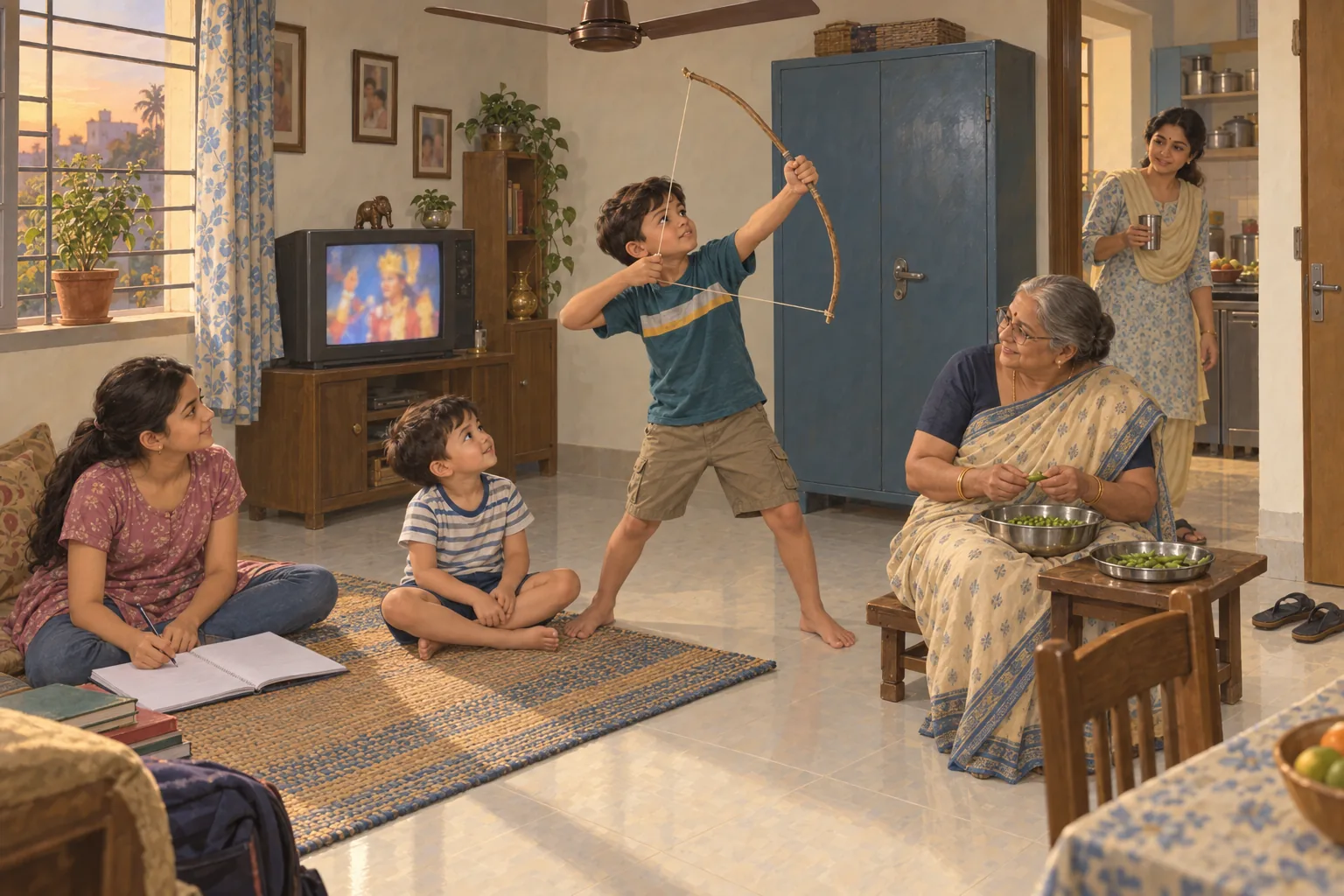 Invented teaching example
An invented scene, to think with. Count the possible models the four-year-old can watch: an older cousin acting out a story from television, a teenage cousin doing homework, a grandmother, a mother, and a costumed hero on the screen. Who will he copy? The Bobo study, with one stranger and one child, cannot answer this. Which of these models carries the most status in his eyes, and which acts would the adults correct?
Learning by watching as the normal way to learn. In the 1950s, the anthropologists Leigh Minturn and John Hitchcock found that Rajput families in Khalapur, Uttar Pradesh, believed that "young children learn new activities best through observation and imitation rather than instruction" (1966, p. 113). Barbara Rogoff and colleagues later studied toddlers in a tribal village in India, a Mayan town in Guatemala, and middle-class families in the United States and Turkey. The Indian and Mayan parents rarely gave toddlers school-like lessons; children learned by taking part in the family's activities (Rogoff et al., 1993). Indian traditions of music, dance and craft teach through the guru-shishya parampara, in which students learn mainly by watching and imitating a teacher over years.
Imitation shaped by hierarchy. These traditions also regulate what may be copied. Ashok Ranade (1998) notes that classical rules for disciples say a student "should not imitate guru's walk or talk". Respect decides which behaviour is to be copied and which is not. A child may learn an elder's acts but be forbidden to perform some of them in front of that elder.
Real aggression from adults. The children in the Bobo study watched an adult hit a toy. Many children in India experience adults hitting them. In a government study of 12,447 children across 13 states, two out of three reported physical abuse, and 65% of school-going children reported corporal punishment at school (Ministry of Women and Child Development, 2007, p. vi). The study used a purposive, not random, sample, so treat the figures as indicative, not exact national rates. India's Right of Children to Free and Compulsory Education Act 2009, Section 17, bans physical punishment and mental harassment in schools for children aged 6 to 14. Corporal punishment at home is still lawful.
Would the findings hold in India?
The answer has two parts.
The basic process very probably holds. Children everywhere learn by watching. Indian communities have long had their own theories of learning by observation and imitation, as the Khalapur and guru-shishya examples show. Indian evidence also links watching or experiencing aggression with later aggression:
- In a six-country study that included a sample of 46 families in Delhi, children whose parents used more physical discipline were more aggressive in every country, although the link was weaker where physical discipline was seen as normal (Lansford et al., 2005).
- In a survey of over 9,000 Indian men in seven states, men who had often experienced violence and discrimination as children had about four times the odds of having been violent towards their partner in the past year (Nanda et al., 2014, p. 46). The report explains this in social learning terms: boys "internalize" violence they observe "as an acceptable behavior".
- Indian policy uses the same reasoning. The National Commission for Protection of Child Rights' Guidelines for eliminating corporal punishment in schools (undated, about 2010) state that "when adults use corporal punishment it teaches their children that hitting is an acceptable means of dealing with conflict" (p. 6).
All of these are correlational studies, not experiments, so they cannot separate copying from other causes such as poverty or stress. And the NCPCR's supporting evidence comes mainly from Western studies, a point the decolonial lens would note.
The specifics might not hold. Who counts as a model, which acts children feel allowed to perform, and in front of whom, may all differ. A child taught not to misbehave before elders might learn a model's acts but not perform them while an adult experimenter is in the room. That is exactly the gap between learning and performance that Bandura later found in 1965. The finding that the male model was copied most may also depend on local gender norms.
We could not find a published direct replication of the 1961 Bobo procedure with Indian children. That gap is itself worth noting in your journal.
What cultural factors matter?
| Factor | Why it matters for this study |
|---|---|
| Family structure | Many possible models at once, including older siblings and cousins, instead of one adult |
| Respect and hierarchy | Affects whose behaviour is copied and whether a child performs it in front of adults |
| Gender norms and son preference | May change how much boys are encouraged, or girls discouraged, to show physical aggression |
| Corporal punishment | Children may already have many real models of adult aggression, aimed at themselves |
| Stories and media | Epics, films and television often show violence by heroes as righteous. Children may learn when violence is "justified", as well as how to do it |
| Language and setting | Verbal aggression, insults and teasing take local forms that an American coding scheme would miss |
| Class, caste and place | Urban middle-class, rural and tribal childhoods differ as much from each other as from 1960s California |
What we do not know about mythological television
When Doordarshan broadcast the Ramayan serial in 1987, it reached a huge national audience, and scholars such as Arvind Rajagopal (2001) have studied its political effects. Many teachers and parents have anecdotes about children acting out battle scenes. But we found no published research measuring whether these serials changed children's aggression. Use the idea as a question, not as evidence.
What examples support or challenge the findings?
Supporting: the Delhi data in the six-country discipline study, the intergenerational violence findings in the men's survey, and the long Indian tradition of learning arts by imitation all fit the idea that children learn behaviour from the models around them.
Challenging or complicating:
- In the Khalapur study, aggression towards adults was treated as a serious offence while aggression among children often went unpunished (Minturn & Hitchcock, 1966, p. 135). The target changed what children learned, a variable the Bobo study did not include.
- The same men's survey found that men living in joint families were less likely to have been violent towards their partner than men in nuclear households (Nanda et al., 2014, p. 45). More adults around may mean more people who model restraint or step in, not only more models of aggression.
- In Israel, children raised on kibbutzim, where group rules against aggression were strong and adults watched television with children, showed no link between viewing violence and aggression (described on the cultural lens page). Strong community norms may outweigh a single model, so Indian community norms could change the effect in either direction.
Try this
You are asked to replicate the Bobo study in a government primary school in rural Bihar. The headteacher offers to be the model 'because the children respect me'.
How might using the headteacher change the results, and what does that tell you about the original study?
Show the reasoning
A respected headteacher has far more status and authority for these children than a stranger did for the Stanford children. Children might copy the headteacher's acts more, because high-status models are copied more. But they might also be confused or frightened to see their headteacher attack a toy, and some might avoid copying because they would not normally imitate a teacher's behaviour in a playful way, given the respect expected towards teachers.
This shows that the original study's model was not a neutral, universal "adult". It was a particular kind of adult in a particular relationship to the children, and the effect of modelling depends on who the model is to the child. A culturally sensitive replication would compare several kinds of local models, such as an older child, a teacher and a stranger.